“Radical Candor” is a book and management philosophy by Kim Scott for effective management of others. The management philosophy rests on two interdependent dimensions:
- Care Personally: Caring about those you manage on a personal level, and honestly so.
- Challenge Directly: Telling people when their work is not good enough – and when it is.
When these dimensions unite, “Radical Candor builds trust and opens the door for the kind of communication that helps you achieve the results you are aiming for.” Those you manage will be more inclined to work with you if you understand and can help them with their personal goals and needs, and by challenging people directly while caring for them you will also find yourself in a position where you can push others towards corrective actions to improve performance.
You can obtain a copy of “Radical Candor” here: https://www.amazon.co.uk/Radical-Candor-Kickass-Without-Humanity/dp/1250103509 (ISBN 978-1250103505).
Radical Candor Matrix
Radical Candor as a concept is best explained by the matrix as shown in the book.
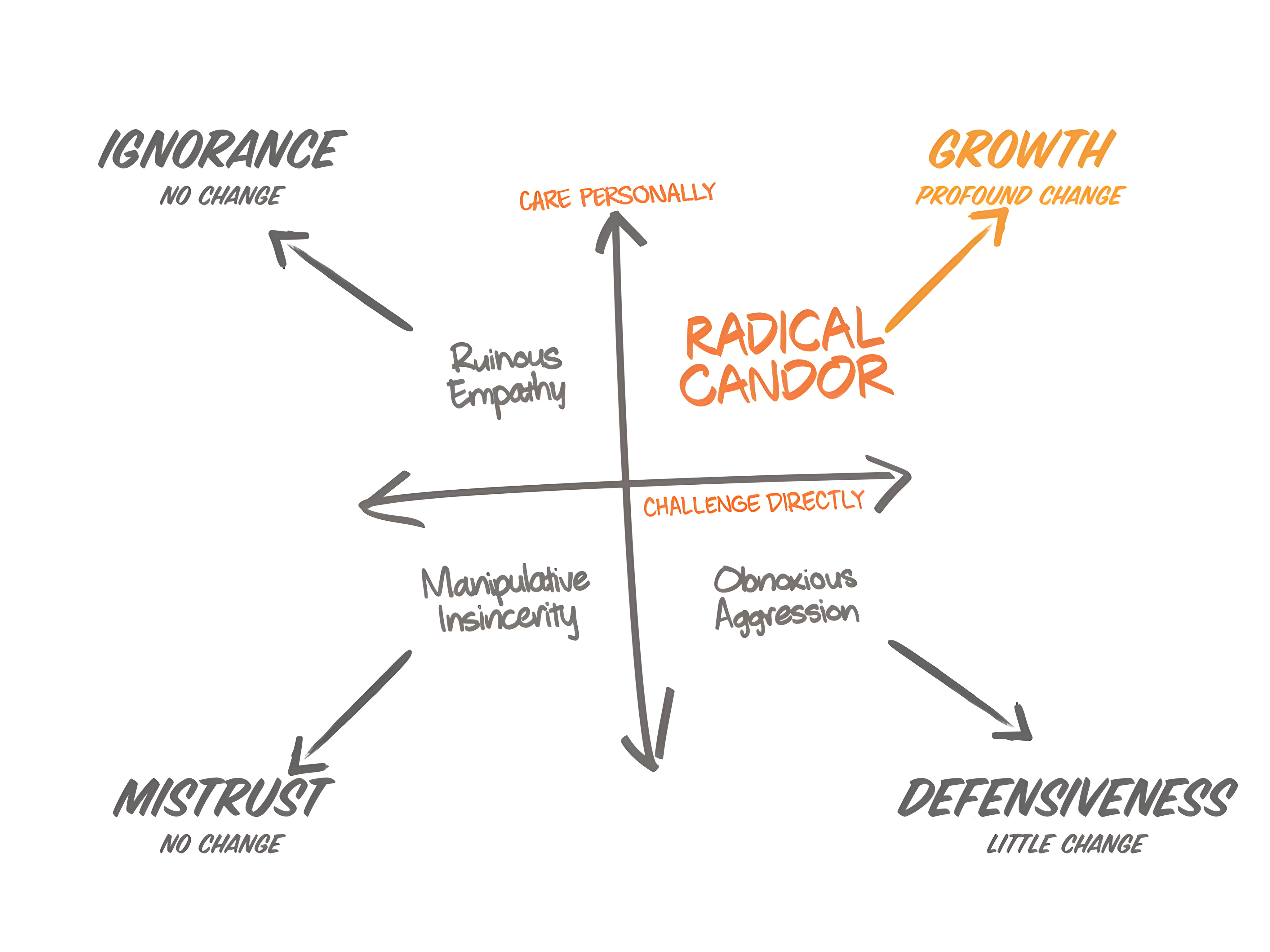
In the sections below we describe each quadrant of this matrix and where all but the Radical Candor quadrant will make you a good manager.
Manipulative Insincerity
Neither caring personally nor challenging directly, this style hides true intentions behind pleasantries or false praise. Feedback is withheld or dished out inconsistently, often to protect oneself rather than help others. It breeds mistrust: people cannot predict whether you will tell the truth or simply tell them what they want to hear.
Ruinous Empathy
When you care deeply about someone but fail to challenge them, you leave problems unspoken. You spare feelings in the moment at the cost of long-term growth. Common signs: avoiding difficult conversations, sugar-coating criticism, letting small issues fester until they become large ones. Citing “King, Warrior, Magician, Lover” this is often the position of the Weakling.
Obnoxious Aggression
You challenge directly but with little or no personal care. Truth is delivered bluntly – sometimes offensively – so that the message lands but the relationship suffers. People learn to fear your feedback, which may get results in the short term but erodes psychological safety and long-term engagement. This style of management is likely to lead to high levels of churn. Citing “King, Warrior, Magician, Lover” this is often the position of the Tyrant.
Radical Candor
At the intersection of caring personally and challenging directly, Radical Candor combines honest, specific feedback with genuine concern for the person. You make clear you value the relationship even as you point out mistakes and offer guidance. This approach builds trust, accelerates development, and sustains high performance.
Radical Candor Guidance
The following sections summarize guidance on how to apply Radical Candor from the passages of the book.
1. Build Trust Through Candid Relationships
Effective management begins with strong one-on-one connections. Scott emphasizes that “the purpose of a 1:1 meeting is to listen and clarify. You must understand what direction each person working for you wants to head in, and what is blocking them.” Use these meetings to demonstrate genuine interest in each individual’s goals and concerns – moving up on the Care Personally axis.
2. Practice Career Conversations
To align roles with motivations and prevent burnout, hold career conversations. These dialogues help you “get to know each of your direct reports better, learn what their aspirations are, and plan how to help them achieve those dreams.” Framing these talks as opportunities to support growth reinforces that you care beyond immediate deliverables.
Note: Applying the PC System, you can design objectives for those you manage to tie career goals on the personal side to wider objectives for the collective. You may for example give staff more complex projects or an area in which to learn and demonstrate a skill to bolster career growth.
3. Deliver Challenging Feedback Immediately and Humbly
Challenging people often feels awkward, yet Scott shows that well-timed, specific feedback “is often the best way to show them that you care when you are the boss.” Pair criticism with a clear signal of your respect and desire for their development. Short, impromptu corrections in private maintain momentum without building resentment.
4. Leverage a Self-Correcting Team Culture
When Care Personally and Challenge Directly become routine, teams develop a “self-correcting quality whereby most problems are solved before you are even aware of them.” Encourage public praise and private critique, and model willingness to receive feedback yourself. Over time, this reduces friction and accelerates collaboration.
5. Kick-Start Adoption with Storytelling
Begin your rollout by “explaining Radical Candor to your team in your own words. Tell your stories… show some vulnerability.” Personal anecdotes help illustrate why candid feedback matters and demonstrate your commitment to the practice.
Directly Challenging the Quality of the Book
Much that one needs to understand about the philosophy of Radical Candor can be understood without reading much of the book or learning much more from the author. Caring personally while challenging directly is compelling, but the book is often diluted by excessive self-promotion, Silicon Valley-centric anecdotes, and a lack of empirical grounding. The text is bogged down by repetitive personal stories and celebrity encounters that serve more to elevate Scott’s profile than to clarify her model. The book itself feels padded to fit a larger page count for publishing, and all that one needs to know may essentially be learned from this summary alone.
Similar Ideas and Historical Underpinnings
Radical Candor synthesizes insights from multiple philosophical and psychological traditions to create a management approach that balances clear, direct feedback with genuine personal care. At its core, it merges:
- Carl Rogers’s concept of “unconditional positive regard” underpins Radical Candor’s care personally axis, stressing non-judgmental acceptance as the foundation for trust and openness.
- Marshall Rosenberg’s Nonviolent Communication (NVC) frames how to express observations, feelings, needs, and requests without blame or coercion, mirroring Radical Candor’s drive to care deeply while speaking honestly.
- Brad Blanton’s Radical Honesty advocates for complete honesty and the elimination of “white lies,” a philosophical antecedent to Radical Candor’s insistence on clear, specific feedback.
- Ray Dalio’s Principles champion “radical transparency” in organizations, influencing Radical Candor’s focus on open information flows and direct challenge.
- Roy Baumeister’s research shows humans weight negative information more heavily than positive, explaining why giving candid criticism feels risky and why Radical Candor pairs criticism with genuine care to offset that bias.
Conclusion
Applying Radical Candor transforms management from a source of anxiety into a catalyst for growth. By caring personally, challenging directly, and weaving these behaviors into one-on-ones, career talks, and everyday feedback, managers build trust, unlock individual potential, and drive superior team results.