The Personal-Collective System (PC System) is a concise, structured framework developed by Dense Analysis to help individuals and groups pursue meaningful, high-value objectives. It uses a four-dimensional scoring model broken down into Fun (“Will I enjoy it?”), Achievement (“What will I gain?”), Ease (“How little effort is required?”), and Impact (“How much good does it do?”). A reference tool is available to visualize where the best objectives may lie. The system is designed to support both solo goal setting and collaborative planning, with guidance, tools, and best practices contributed and refined through real-world use.
Conventional Wisdom and Connected Ideas
💡 Note: Please consult the following sub-pages for collective wisdom from authors and thinkers from around the world and across time that complement the PC System and build toward a shared Dense Analysis philosophy.
- 🤝 How To Win Friends and Influence People
- 🏛️ The Mythical Man-Month
- 👑 King, Warrior, Magician, Lover
- 🎚️ The Eisenhower Matrix
- 🗣️ Radical Candor
Why Have a System?
Systematizing objective setting helps clarify a vague and difficult topic: how to set goals for yourself or others. The PC System provides a means to quickly and efficiently discover the most appropriate goals for an individual by weighing personal interests and growth opportunities against goals of a collective. Adding clarity and efficiency to objective setting reduces tensions between individuals as each individual will tend to achieve more for themselves and others.
The PC System introduces an algorithmic guide for objective setting to function as an advisory tool, complete with a reference implementation that is freely available online. The PC System tool can be applied with the web browser reference implementation. It can be sketched out on paper, drawn on a whiteboard, or otherwise applied.
The PC System encourages general application of a Dense Analysis philosophy for work that combines the conventional wisdom of several key authors, lecturers, project managers, philosophers, and more. Importantly, the PC System and the shared Dense Analysis philosophy of work encourage critical thinking, with the ultimate aim of selecting the most valuable work and improving performance, both personal and collective, in pursuit of high-level goals.
The System — Two Worlds, Two Planes
The PC System captures the following four dimensions, that answer four important questions, which are separate factors. You may rate an objective separately higher or lower across these four dimensions. The goal is to find objectives that optimize the most for all four dimensions.
- (F) “Fun” — Will you personally enjoy working on the objective? How much happiness will completing the objective bring you as you work on it?
- (A) “Achievement” — Will you personally gain from completing the objective? How much will you achieve from completing the objective?
- (E) “Ease” — Will completing the objective be easy or require low collective effort? How easy will completing the objective be?
- (I) “Impact” — Will completing the objective have a high collective impact? How impactful will completing the objective be?
In the western world we read information from left to right, and the system has been designed such that the dimensions can be drawn on two personal and collective planes where the label for a vertical y-axis appears first, and the label for a horizontal x-axis appears second. Written as a series of mathematical values as four dimensions, we can see the four dimensions mathematically as such.
$$ (A, F, I, E) $$
You can remember which dimensional components the system includes by the sound “/a fee/,” or you can say “a fee,” as in, “you pay a fee in time to complete objectives.” The four dimensions can be split into separate coordinates for the personal and collective sides as such.
$$ ((A, F), (I, E)) $$
Splitting the four dimensions into two separate planes makes it possible to
plot values on a graph. For the system we will constrain all values to be
normalized between 0 and 1, and values can be multiplied by the size of a
plot on a computer screen to fit to any size of chart. Let us take an example
where we have defined three objectives, and we have already arrived at numeric
values between 0 and 1 to rate those four objectives.
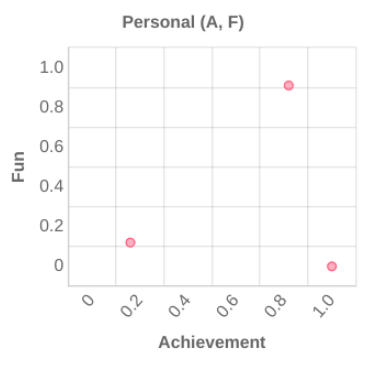
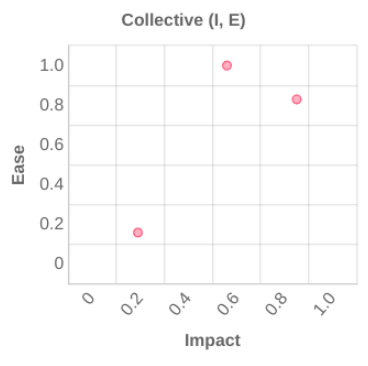
| Name | (A) Achievement | (F) Fun | (E) Ease | (I) Impact |
|---|---|---|---|---|
| Objective 1 | 1 | 0 | 0.56 | 1 |
| Objective 2 | 0.82 | 0.91 | 0.85 | 0.83 |
| Objective 3 | 0.16 | 0.12 | 0.19 | 0.16 |
Splitting the Personal and Collective dimensional components into two separate planes, we could achieve drawings as such.
Being able to visualize how objectives compare against each other in each
separate plane simplifies how you think about those objectives. It is important
to view the Personal and Collective benefits separately. It is also
important to view the combined values for how much an objective would benefit
either the Personal or the Collective. In order to do this, we need a
means of dimensional reduction to again view the values on a simple
two-dimensional plane, where we arrive at the values (C, P) from a function
f like so:
$$ (C, P) = (f(A, F), f(I, E)) $$
We will define our function f mathematically as such:
$$ f(x, y) = \frac{\frac{\sqrt{x^2 + y^2}}{\sqrt{2}} + x \cdot y}{2} $$
This dimensional reduction function f is composed of the following steps.
- Euclidean Norm ($\sqrt{x^2 + y^2}$) — The distance from the origin for the two dimensions.
- Normalization — Dividing the Euclidean Norm by the square root of 2 ($\frac{…}{\sqrt{2}}$) normalizes the result of the Euclidean Norm between $0$ and $1$, producing a normalized Euclidean Norm.
- Multiplication ($x \cdot y$) — Produces a simple adjustment on the strength of the two dimensions, to bias results lower if one value falls lower.
- Average ($\frac{…}{2}$) — Produces the average of both the normalized Euclidean Norm and also multiplication to arrive at a value that is pushed smoothly along from $0$ to $1$, biasing slightly to lower results where one value falls lower, without pushing values too extremely low.
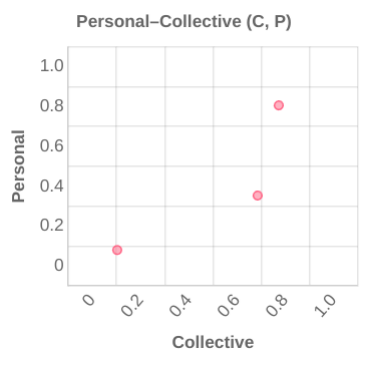
By applying our function f to the results above, we can arrive at the
following results in a combined PC plane. (Results rounded up to three decimal
places.)
| Name | (C) Collective | (P) Personal |
|---|---|---|
| Objective 1 | 0.685 | 0.354 |
| Objective 2 | 0.773 | 0.806 |
| Objective 3 | 0.103 | 0.08 |
You can view the results in the reference PC System tool by uploading the following CSV.
name,achievement,fun,impact,ease
Objective 1,1,0,0.56,1
Objective 2,0.82,0.91,0.85,0.83
Objective 3,0.16,0.12,0.19,0.16
Improving “Ease”
One important consideration when applying the system is you may consistently arrive at results that suggest that some or all objectives are not easy enough. You should be encouraged to provide training, apply the correct tools, and find any means necessary to make objectives easier to achieve. By weighting objectives down by “Ease” you may find a need for more training to promote the “Ease” value for an employee, or you may find the need for the application of particular tools to improve “Ease.”
Dense Analysis recommends the following tools for making your life easier.
- When writing code, use the DAFT. Good editors, linters, code fixers, and AI tools will make writing code and working with DSLs much easier.
- Choose simpler solutions over more complex solutions wherever possible. Follow the KISS principle.
Applying the PC System in the Real World
One of the purposes of the PC System is to assist employers and workers with a means to get more for themselves, and to assist companies and work groups with getting the best out of employees and workers. Consider the following example scenarios where dimensions might be weighted differently and in the balance give a clearer picture as to which objectives are the most important and how to select them.
Scenario: Mid-level engineer at risk of burnout
An engineer regularly delivers but feels stagnant. Management assigns them to co-lead a small R&D project exploring a new tech stack they are curious about.
- Collective benefit: Retains a reliable, experienced team member and avoids disruption from turnover. The R&D project surfaces new tooling insights that benefit multiple teams.
- Personal gain: High “Fun” and “Achievement” through creative work and skill development. Renewed motivation leads them to stay and re-engage with broader technical goals.
Scenario: Senior contributor re-engagement
A long-standing contributor feels their work has become repetitive. They are asked to lead a hack week on experimentation or shadow a product manager for a sprint.
- Collective benefit: A visible senior team member sets a tone of curiosity and initiative, inspiring others and generating new experimentation pathways.
- Personal gain: Gains “Fun,” “Impact,” and “Achievement” by breaking monotony, expanding perspective, and influencing product direction and reigniting their sense of purpose.
Scenario: Giving up a preferred tech stack for team alignment
An experienced contributor prefers a bleeding-edge stack but is asked to build using a legacy system to ensure maintainability and faster ramp-up for new hires. This is an example where personal “Fun” might be low, but an objective is otherwise weighted high.
- Collective benefit: Reduced onboarding time, unified tooling. The solution may favor “Ease” at equal “Impact” so the collective benefits to the same degree in a smaller time frame.
- Personal tradeoff: Less fun, more constraints.
- Long-term gain: They become the recognized expert on migration strategy and tech debt management, leading future replatforming efforts, which scores high in terms of “Achievement.” The collective may achieve their goals with less delay to ship if estimated effort can be shown to be less.
Scenario: Building an internal joke tool for during downtime
An idea is formed to spend time building an internal joke tool for boosting employee morale. This is an example where an objective may be quite “Fun” but might not be selected due to low weighting along other dimensions.
- Collective benefit: Low direct impact, but may raise morale.
- Personal tradeoff: Low achievement and impact formally.
- Personal gain: High fun, high ease, and potential indirect impact through team bonding.
Deciding Numeric Values
It is difficult to quantify objectives in terms of numeric values from 0 to
1 by examining objectives in isolation. Dense Analysis recommends considering
at least a handful of objectives and weighting them against each other in terms
of each of the individual four dimensions. Similar to rating your favorite
songs or movies, it is much easier to set a numerical rating for each
individual selection when weighting several examples together. The reference
tool sliders will help with visually balancing different objectives. As an
alternative, you might write each of the objectives ranked from top to bottom
along each individual objective and then use the ranking to decide numerical
weights.
In the example below we have taken a series of objectives, and individually ranked them in order top to bottom. The objectives described here are arbitrary and used simply to demonstrate how to rank objectives along different dimensions.
| Rank | Fun | Achievement | Ease | Impact |
|---|---|---|---|---|
| 1 | (a) Lead Hack Week | (c) Give Conference Talk | (h) Team Health Check | (j) Refactor Legacy Code |
| 2 | (b) Build Slack Bot | (d) Experimental R&D Sprint | (b) Build Slack Bot | (a) Lead Hack Week |
| 3 | (c) Give Conference Talk | (a) Lead Hack Week | (g) Write Docs | (c) Give Conference Talk |
| 4 | (d) Experimental R&D Sprint | (j) Refactor Legacy Code | (f) Improve Onboarding | (f) Improve Onboarding |
| 5 | (e) Mentorship Program | (e) Mentorship Program | (i) Accessibility Audit | (e) Mentorship Program |
| 6 | (f) Improve Onboarding | (b) Build Slack Bot | (d) Experimental R&D Sprint | (g) Write Docs |
| 7 | (g) Write Docs | (g) Write Docs | (j) Refactor Legacy Code | (d) Experimental R&D Sprint |
| 8 | (h) Team Health Check | (f) Improve Onboarding | (c) Give Conference Talk | (b) Build Slack Bot |
| 9 | (i) Accessibility Audit | (i) Accessibility Audit | (e) Mentorship Program | (i) Accessibility Audit |
| 10 | (j) Refactor Legacy Code | (h) Team Health Check | (a) Lead Hack Week | (h) Team Health Check |
You can determine values with the formula
v = ((n - x) / (n - 1)) where n is the bottom rank number, in this case
10, and x is the rank of an individual item. For example, the
“(f) Improve Onboarding” objective, bolded above, would rank along each
dimension as such.
$F = ((10 - 6) / (10 - 1)) = 0.44…$
$A = ((10 - 8) / (10 - 1)) = 0.22…$
$E = ((10 - 4) / (10 - 1)) = 0.66…$
$I = ((10 - 4) / (10 - 1)) = 0.66…$
$P = f(A, F) = \frac{\frac{\sqrt{A^2 + F^2}}{\sqrt{2}} + A \cdot F}{2} \approx 0.23$
$C = f(I, E) = \frac{\frac{\sqrt{I^2 + E^2}}{\sqrt{2}} + I \cdot E}{2} \approx 0.55$
Below we have computed the values for every objective and displayed them ranked by collective and personal scores.
| Objective | Fun | Achievement | Ease | Impact | Personal | Collective |
|---|---|---|---|---|---|---|
| (f) Improve Onboarding | 0.44 | 0.22 | 0.67 | 0.67 | 0.23 | 0.55 |
| (j) Refactor Legacy Code | 0.00 | 0.67 | 0.33 | 1.00 | 0.24 | 0.54 |
| (g) Write Docs | 0.33 | 0.33 | 0.78 | 0.44 | 0.22 | 0.49 |
| (b) Build Slack Bot | 0.89 | 0.44 | 0.89 | 0.22 | 0.55 | 0.42 |
| (c) Give Conference Talk | 0.78 | 1.00 | 0.22 | 0.78 | 0.84 | 0.37 |
| (h) Team Health Check | 0.22 | 0.00 | 1.00 | 0.00 | 0.08 | 0.35 |
| (a) Lead Hack Week | 1.00 | 0.78 | 0.00 | 0.89 | 0.84 | 0.31 |
| (d) Experimental R&D Sprint | 0.66 | 0.89 | 0.44 | 0.33 | 0.69 | 0.27 |
| (e) Mentorship Program | 0.56 | 0.56 | 0.11 | 0.56 | 0.43 | 0.23 |
| (i) Accessibility Audit | 0.11 | 0.11 | 0.56 | 0.11 | 0.06 | 0.23 |
Your Own Collective
One important consideration for the PC System is that the system can be used entirely for setting objectives for sole traders, self-employed individuals, in your own personal life, and so on. The “collective” for the collective aspect of the system could extend only as far as your friend group, your family, or even yourself alone. The system can be used entirely to benefit only an individual as well as it could mutually benefit a wider collective as well as the individual. The system is therefore not merely a bridge between individualism and collectivism, but a universal tool. Examples of objectives solely for an individual may include the following.
- Filing personal taxes — Most would not find filing personal taxes enjoyable, so not much “Fun,” but doing so achieves a lot for the individual, so high “Achievement.” Filing personal taxes has a massive “Impact.” Filing taxes may not be easy, so low “Ease.” Note that you might select tax filing tools to improve the ease of completing the work.
- Physical fitness — Depending on the individual, maintaining physical fitness may require an attitude change for it to be considered “Fun” and is certainly not easy for most individuals, so low “Ease.” Still, any sensible person must agree that being in greater physical health carries a high “Impact” and is a great “Achievement.” A healthier individual is able to live longer and achieve more for themselves and others.